
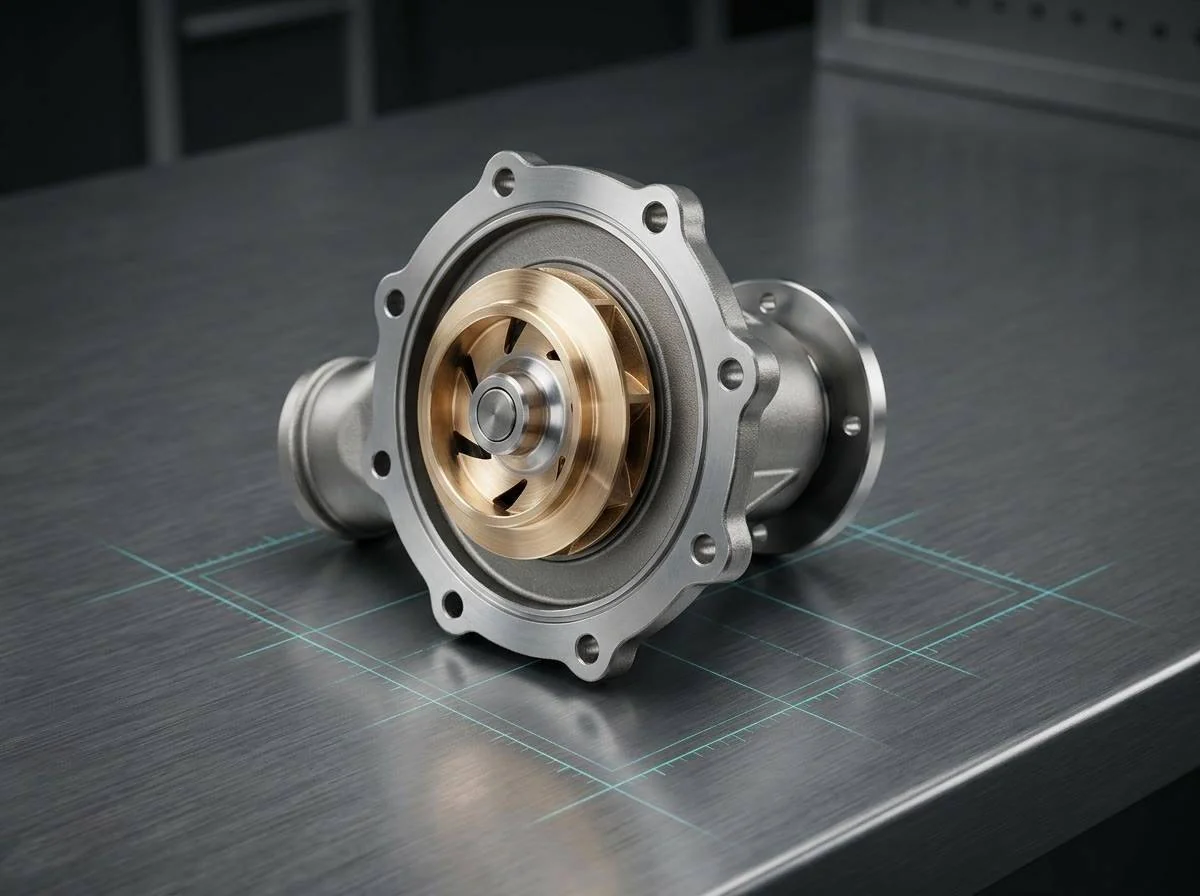
1. Mechanics of Impeller Cavitation in Heavy Diesel Applications
Cavitation occurs when local static pressure inside the impeller suction zone drops below the saturated vapor pressure of the coolant fluid. At typical operational engine temperatures (85°C to 95°C), microscopic vapor cavities violently form.
As these bubbles travel into higher-pressure zones, they collapse with micro-jet impact forces exceeding 1,000 MPa, eroding standard aluminum and gray iron impellers into pitted sponge-like surfaces within months.
2. TRUCKO Ductile Iron Impeller Engineering Solution
To permanently eliminate cavitation pitting, Paya Yadak Asia (TRUCKO PART Brand) manufactures heavy water pump impellers exclusively from DIN EN 1563 GGG50 ductile nodular iron.
Precision 5-axis CNC blade contouring guarantees laminar coolant velocity profiles across full torque bands, paired with silicon carbide mechanical face seals.
| Engineering Property | Standard Aftermarket Impeller | TRUCKO GGG50 Ductile Impeller |
|---|---|---|
| Material Grade | Die-Cast Aluminum / Gray GG20 | Spherical Graphite GGG50 Ductile Iron |
| Hydraulic Shock Resistance | Low (Prone to pitting) | Ultra-High (100% Anti-Cavitation) |
| Mechanical Seal Type | Carbon Ceramic | Heavy Silicon Carbide (SiC) |
| Dynamic Balancing Tolerance | ±5 g·cm | Sub-0.5 g·cm CNC Dynamic Balance |
3. Fleet Maintenance Protocol & Installation
Always power-flush the engine cooling block and radiator prior to installing a new replacement pump.
Maintain a strict 50/50 ratio of demineralized water and organic acid technology (OAT) heavy diesel coolant.
Never apply axial impact hammer force to the pump drive shaft during pulley fitment; torque mounting bolts to 38 Nm.
Require Tier-1 Fleet Supply or Engineering Consultation?
Connect directly with Paya Yadak Asia (TRUCKO PART) Sales Engineering